Why Code Health Is Suddenly the Hottest Topic in Engineering Teams

(And why your velocity chart is silently judging you.)
Engineering used to be simple.
Well—“simple” in the way assembling IKEA furniture is simple: technically doable, emotionally scarring. You wrote code. You shipped code. If things exploded, you patched it at 11 PM with coffee and regret.
But 2025 engineering? It’s a whole new game.
Suddenly, every CTO is talking about code health the way fitness influencers talk about protein intake: obsessively, aggressively, and always with a side of moral superiority.
And honestly? They’re not wrong.
We are seeing a massive shift in how engineering organizations operate. We are moving from a "ship at all costs" mentality to a "ship sustainably" reality. So, what’s happening? Why does “code health” matter now more than ever?
Three major shifts collided at once.
1. AI tools started revealing how messy our repos actually are.
Before, legacy code was like that junk drawer everyone has in their kitchen—full of cables from phones you don’t own anymore and batteries that might be dead. You knew it was a mess, but as long as you didn't open it, it wasn't a problem.
Now, AI tools are scanning entire codebases and saying: "Hey, did you know 37% of your codebase is duplicated and your dependency graph looks like a bowl of Maggi?"
Teams can't hide behind “We’ll refactor later” anymore. AI sees everything. It has turned the lights on in the basement, and we can no longer ignore the clutter.
2. Regulators are stepping into engineering workflows.
Governance used to be optional—something for the legal team to worry about. Now? It’s an engineering constraint.
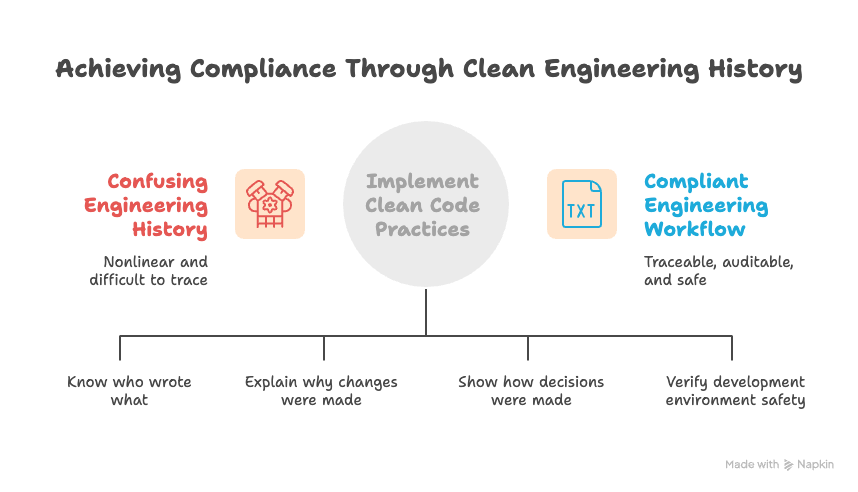
With new rules around AI usage, traceability, and compliance (think SOC2, ISO, and AI safety standards), teams must be able to show:
- Who wrote what.
- Why it changed.
- How decisions were made.
- Whether the development environment was safe.
You can’t show any of that if your engineering history looks like the plot of a Christopher Nolan movie—nonlinear and confusing. Clean code entails clean history, which equals compliance.
3. Engineering leaders finally realized velocity is a vanity metric.
A team can ship fast... but not sustainably, not predictably, and definitely not safely—if the underlying code is a mess.
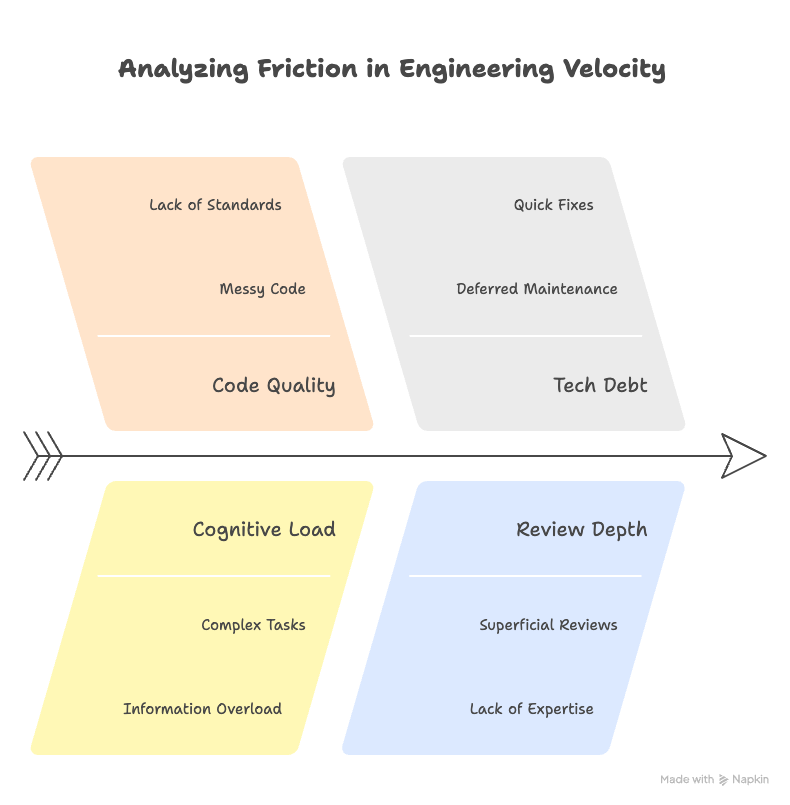
We used to celebrate the sprint velocity. But now, smart companies are measuring the friction that slows that velocity down:
- Code Quality
- Cognitive Load
- Tech Debt
- Review Depth
Velocity still matters. But it’s no longer the star of the show—it’s just one member of the cast.
The Uncomfortable Truth: Code Health Predicts Delivery Health
Everyone wants high-velocity teams. But here is the reality: You can’t sprint your way out of bad architecture.
When code health drops, everything slows down. PR reviews take longer because the logic is convoluted. Handoffs get messy because documentation is stale. Bugs multiply. Onboarding becomes a nightmare for new hires who spend weeks just trying to set up their local environment.
Once confidence and visibility disappear, chaos quietly becomes your operating system.
This is the thing executives are finally understanding: Engineering doesn’t collapse suddenly. It collapses gradually—one unreviewed PR at a time.
Why AI is Accelerating the Code Health Movement
At EvolveDev, we see AI doing two interesting things simultaneously:
1. It shows exactly where the problems are. AI-based observability platforms map bottlenecks, stale branches, PR loops, and unclear ownership. You can argue with a Manager, but you can’t debate a screenshot of your own workflow analytics.
2. It gives teams a path to fix it. This is the part nobody expected. AI isn't just a narc; it's a coach. It can suggest refactors, reduce cognitive load by rewriting complex logic, and flag ownership issues. AI has become that brutally honest friend who says: "I’m not saying your code is bad—but it could be better, and here is exactly how."
The "Funny" Part: It’s About People, Not Just Code
Here is the twist teams are discovering: Code health issues are rarely just technical issues. They are alignment issues.
- Every PR that sits for 4 days? That’s not a coding issue—that’s a coordination issue.
- Every engineer doing “drive-by commits”? That’s not a tooling issue—that’s an ownership issue.
- Every sprint that derails? That’s not a planning issue—that’s a visibility issue.
Code health is ultimately People Health reflected in Git.
What Should Teams Do Now?
If you are an Engineering Manager or VPE looking at your dashboards and sweating, here is the practical path forward:
- Start measuring what actually matters. Stop obsessing over Burndowns and Story Points. Look at indicators that reflect reality: Review response times, refactor cadence, and tech debt % vs. active work.
- Don’t normalize chaos. If your team needs heroics to ship every sprint, that’s not "hustle culture"—that’s a cry for help.
- Make code health part of the roadmap. It cannot be an afterthought or "something we’ll get to if we survive Q3." It needs to be a first-class citizen in your planning.
- Use AI to reduce the load, not replace judgment. AI won’t fix your culture. But it will expose it. Use that visibility to drive conversations, not just to generate more code.
The Bottom Line
2025 engineering isn’t about shipping more. It’s about shipping cleaner, clearer, and more sustainably.
High-performing teams don’t win because they are fast. They win because they stay fast as complexity grows. And the real unlock isn’t more engineers, more tools, or more sprints.
It’s healthier code. Because healthy code creates healthy teams. And healthy teams ship like magic.
How EvolveDev Turns the Lights On
This is exactly why we built EvolveDev.
We realized that engineering leaders don’t need another tool to manage work; they need an intelligence layer to understand it.
Most tools treat code health as a separate checklist item. EvolveDev treats it as the heartbeat of your engineering operation.
We connect the dots that everyone else leaves disconnected:
- We visualize the "Black Box": Our AI-driven insights don't just count PRs; they reveal the friction points in your process—showing you exactly where bad code is slowing down good teams.
- We quantify the "Human Cost": We link technical debt directly to Developer Experience (DevEx) and burnout metrics. So when you say, "This module needs a rewrite," you have the data to prove it’s hurting your team’s retention.
- We translate "Refactoring" into "Business Value": With our Investment Dashboard, you can finally stop begging for budget to fix tech debt. We help you prove to the C-suite exactly how much R&D budget is being wasted on "maintenance" versus "innovation," turning a technical argument into a financial one.
Stop guessing where your velocity is going. Stop letting your code health deteriorate in the dark.
EvolveDev gives you the intelligence to build a high-performing, high-velocity, and—most importantly—healthy engineering organization.
EvolveDev Login and let’s turn the lights on.