The AI Scaling Problem: McKinsey's 2025 Report Shows What's Holding Engineering Leaders Back


A new report from McKinsey called "The State of AI in 2025: Agents, Innovation, and Transformation" just brought to light the main problem that every tech leader is facing: adoption is huge, but actual, measurable value is hard to find.
First, here is our summary of the report's key findings:
Our Summary: The State of AI in 2025
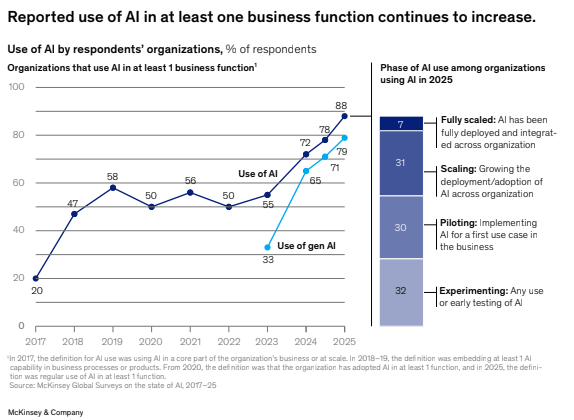
McKinsey's global survey paints a clear picture: AI is now commonplace, but its integration is shallow. While nearly nine out of ten organizations (88%) report regularly using AI in at least one business function, the vast majority are stuck.
- Most are Not Scaling: Nearly two-thirds of respondents say their organizations have not yet begun scaling AI across the enterprise. They are stuck in the "experimenting" (32%) and "piloting" (30%) phases.
- Real-World Impact is Missing: While 64% say AI is enabling "innovation,"only 39% report any EBIT impact at the enterprise level. The connection to business value is broken for most.
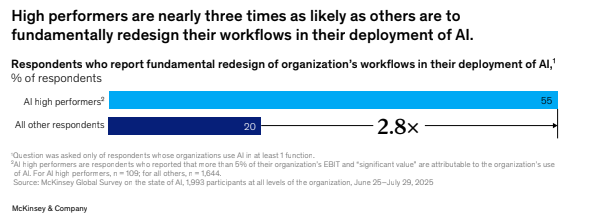
- "High Performers" Have a Different Playbook: The 6% of companies that are seeing significant EBIT impact (5% or more)don't just focus on efficiency. They aim for transformative change, focus on growth and innovation, and are 2.8 times more likely to fundamentally redesign workflows.
- Software Engineering is a Key Benefit Area: When looking at functional impact, respondents most commonly reported cost benefits from AI in software engineering.
- Risk is a Major Concern: The top-experienced negative consequence of AI is inaccuracy (30% of orgs), and explainability is a top-three risk.
Analysis: What This Report Really Means for Engineering Leaders
This report is a big warning sign for VPs of Engineering and CTOs. It points out three important gaps that set high-performing businesses apart from the rest.
1. The Gap Between "Using AI" and "Scaling AI"
The report's biggest finding is the "scaling gap": 88% of companies use AI, but nearly two-thirds haven't scaled it. This suggests that while it's easy to approve a new tool or run a pilot, it is incredibly difficult to embed AI into the core fabric of the business.
The high-performers provide the clue: they are 2.8 times more likely to "fundamentally redesign individual workflows". The gap for everyone else implies a massive organizational challenge. Companies are struggling to move from using AI in pockets to basing their operations on it.
2. The Gap Between "Engineering Activity" and "EBIT Impact"
The most damning statistic in the report is the gap between what people think is innovative and what actually makes money. It's clear that most AI projects aren't linked to bottom-line value because 64% of respondents said AI leads to innovation but only 39% saw any EBIT impact.
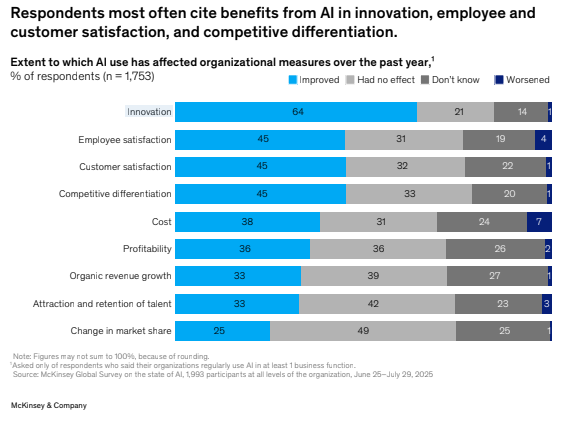
This "Value Gap" shows that the engineering and R&D departments are having a hard time turning their technical work into terms that the C-suite can understand. The high performers, who are seeing a 5%+ EBIT impact, have clearly figured out how to connect their AI projects directly to business value. The other 94% of organizations have not yet learned how to do this.
3. The Gap Between "AI Hype" and "AI Trust"
The report says that "inaccuracy" is the biggest risk that businesses have faced, and "explainability" is one of the top three worries. This is a huge problem for scaling.
You can't "fundamentally redesign" a workflow with a tool you don't trust or understand. This "Trust Gap" shows that companies are having big problems with reliability and transparency as they try to move from small tests to mission-critical deployment. This naturally stops more people from using it, since leaders don't want to risk their operations on systems that aren't reliable or are "black box."
Stop Buying Hype, Start Building Your Engine
The McKinsey report is a warning. The 94% of companies failing to see value are trying to bolt AI onto an invisible, broken, or misaligned foundation.
The "AI high performers"are simply those who are already running a high-performance, data-driven organization. They have visibility. They have mastered their People, their Process, and their Business Impact.
Before you invest another dollar in the AI "hype cycle", you must get visibility. Invest in the Engineering Intelligence platform that lets you see, measure, and improve the engine that actually runs your business.