The AI Paradox - Why Speed Is Now The Engineering Leader's Biggest Problem

The narrative is settled: AI coding tools work. Data shows 78% of companies are now using AI, and upwards of 90% of tech workers use AI tools for tasks like code generation. Microsoft customers report a 30% boost in developer efficiency, and the market for generative AI in software development is soaring.
This is a victory for the individual contributor, but for the Engineering Leader, the VP, the Director, the Staff Engineer, this productivity surge has quietly created their next, and perhaps most urgent, crisis: The AI Productivity Paradox.
The paradox is simple: Speed doesn't automatically mean quality or strategic value.
For years, the engineering pain point was developer velocity, how fast we can write and ship features. AI solved that. Now, the new choke point is code orchestration and governance, how effectively a team of rapidly producing engineers can maintain a cohesive, secure, and scalable system.
The core job of the engineering leader hasn't changed; it's still to deliver reliable software, but the nature of the challenge has fundamentally shifted. They are no longer managing a scarcity of code but an abundance of it.
The New Bottleneck: Architecting in an Age of Code Abundance
In an early-stage SaaS environment, where every line of code is a fundamental brick in the foundation, this paradox is amplified.
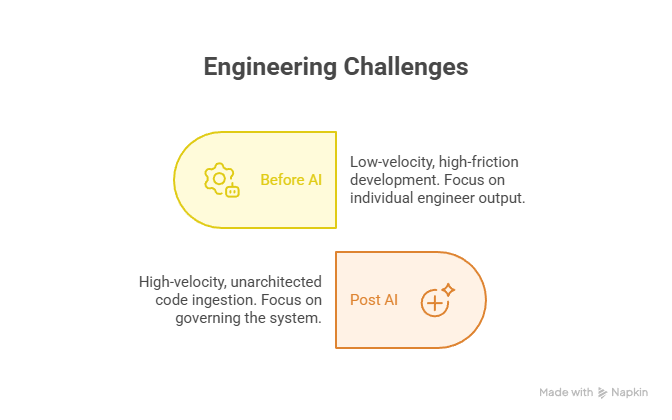
Before AI, the problem was low-velocity, high-friction development. Engineering leaders worried about engineers spending too much time on boilerplate, debugging, or writing initial tests. The focus was on unlocking the individual engineer's output.
Post-AI, the problem has transformed into high-velocity, unarchitected, potentially high-debt code ingestion. Engineering leaders now face a different pain: Senior resources, Tier 4-6 engineers are drowning in architecture reviews, security fixes, and technical debt from AI-assisted code that is locally optimized but globally unscalable. The focus has shifted to governing the system to ensure the collective output is correct, secure, and aligned with long-term strategy.
The Senior Engineer, the most expensive, strategic resource, is now wasting time reviewing pull requests where the underlying code is technically correct but strategically flawed. It passes unit tests but violates the core architectural pattern. It's fast, but it doesn't fit.
This isn't a theory; it's the emergent reality. The most senior engineers are transitioning from building to risk assessment and quality control at an unsustainable rate. The "30% boost" at the IC level is causing a 30% drag on the leadership layer.
The Three Fatal Cracks in the AI-Accelerated Foundation
Engineering leaders who are focused purely on the speed of development will see their foundations crack in three ways:
The Security/Quality Lag
AI-generated code, while often syntactically correct, frequently misses subtle, system-specific security or quality guardrails. The new developer's "Hippocratic Oath" must prioritize quality and security, but generative AI's default behavior favors completeness over soundness. The security and QA review process, still fundamentally human-driven for complex systems, now lags further behind the rapid code generation, creating a critical vulnerability gap.
The Architectural Divergence
The core job-to-be-done of a Staff Engineer is to ensure platform-wide architecture at Tier 4-5 complexity. AI-assisted coding optimizes for the function or file the IC is currently working on. It doesn't know the future scaling needs, the event-driven system pattern, or the critical path for the next five features. If the IC relies too heavily on local AI context, the codebase rapidly becomes a collection of brilliant fragments that, together, form an incoherent and unmaintainable mess. The resulting technical debt scales non-linearly.
The Knowledge Silo and Skill Erosion
When AI writes the boilerplate and suggests the solution, the Mid-level Engineer skips the vital, frustrating, deep-dive learning that creates a Senior Engineer. They go from problem statement to solution without the necessary struggle of understanding why the bad solutions fail. This erodes the long-term strategic capability of the team. The Engineering Leader's risk is the creation of a "hollowed-out middle management", a team that is fast at production but fragile at problem-solving.
The Solution: Pivot from Velocity Tooling to Governance Tooling
For an early-stage SaaS company, this paradox presents a clear market white space. The GTM priority must shift from selling to the IC, the user of the code, to selling to the Leader, the custodian of the system.
The new value proposition is not "Write code 30% faster." It is: "Govern your 30% faster codebase to prevent 100% architectural failure."
The early traction metric for any product addressing this must be qualitative, tied directly to the Senior Engineer's most painful job-to-be-done. When Engineering Leaders struggle to spend less time correcting architecture violations in PRs, the solution should proactively enforce architectural patterns before the code is reviewed, with success measured by a reduction in PR comment threads related to system design by 40%.
When leaders need to ensure all new code meets the company's internal security standards, the answer is to auto-generate secure boilerplate that adheres to specific, internal policy frameworks, tracked through a reduction in security findings flagged by static analysis tools on new feature branches.
When the concern is reducing high-risk 'hollow' code submissions, providing an in-IDE, system-aware context for AI tools ensures alignment with platform architecture, measured by an increase in code deployment frequency without a corresponding rise in Mean Time To Recovery.
The market is saturated with speed tools. The emerging demand is for safety, governance, and structural integrity tools that help the Engineering Leader manage the output of the AI-accelerated team. This is where the next wave of foundational SaaS value will be built.
Validating the Engineering Leader Pain
This analysis operates on the hypothesis that the Tier 4-6 Engineering Leader VP, Director, Staff Engineer is now suffering from an AI-induced architectural and governance bottleneck. This needs validation before any large-scale content strategy or product feature development.
The core hypothesis is that the most acute pain point for early-stage SaaS Engineering Leaders is no longer "developer velocity" but "managing the quality and architectural debt of AI-accelerated code."
To test this, a targeted outbound and interview blitz over a two-week sprint should reach 50 named Engineering VPs, Directors, and Staff Engineers at Seed and Series A SaaS companies. The outreach should challenge the "30% productivity gain" narrative directly, asking: "We're finding the 30% AI boost just shifts the bottleneck to your Staff Engineers. Are you now spending more time on architectural corrections in PRs than you did 6 months ago?"
Success would mean a reply rate and interview acceptance rate greater than 10%, combined with a qualitative confirmation rate above 50%, where leaders explicitly confirm the sentiment: "Yes, my seniors are now code review janitors." A high reply rate to this specific, skeptical message would indicate the pain is real and resonates deeply enough to break through their noise.
If the signal is met, the move is to double down on the Governance and Architecture narrative. If the signal is missed, the paradox is not yet acute enough for the ideal customer profile, and a pivot back to a more conventional "AI-enabled quality" positioning becomes necessary.
This serves as the first low-cost test asset to check for market resonance before committing to a full go-to-market strategy based on the "AI Paradox" framing.