From Guesswork to Guidance: A Data-Driven Playbook for Hitting Deadlines

As a leader in engineering, you always have one question on your mind: "Will we ship on time?"
To answer it, you've made a list of heroic, hard-earned "hacks." You are a detective, a coach, and a leader all at the same time.
Does this playbook look familiar?
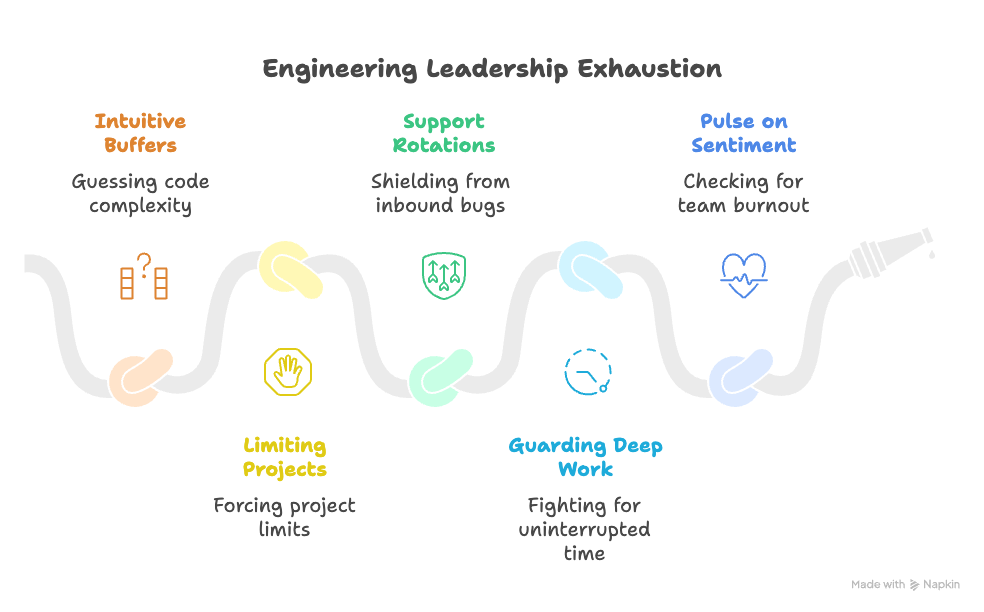
- You "get a feel" for the codebase: You intuitively add buffers to estimates because you just know a certain part of the code is complex.
- You limit "projects in flight": You manually force a limit of 1-2 projects per sprint because you know parallel work slows everything down.
- You create support rotations: You shield your team from the firehose of inbound bugs to protect their "feature delivery" time.
- You guard "deep work": You implement "No-Meeting Wednesdays" and async standups, fighting to give your engineers the uninterrupted time they need.
- You keep a "pulse on sentiment": You run regular pulse checks to see if your team is approaching burnout.
These are the right moves. They are the hallmarks of a good, empathetic manager. But let's be honest: it's exhausting.
Why? Because you have to manage from a "black box." Instead of facts, you're making important choices based on gut feelings, t-shirt sizes, and "perceptual data." You are reacting to problems instead of stopping them before they happen.
These "hacks" aren't a strategy. They are symptoms of a deeper problem: a lack of visibility.
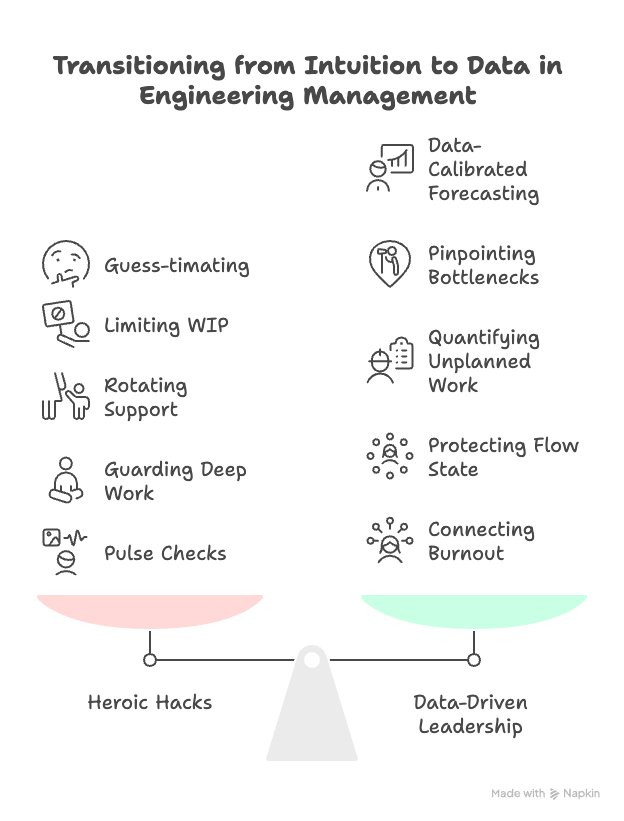
From "Heroic Hacks" to "Data-Driven Leadership"
What if you didn't have to take a guess? What if you could use "insight" instead of "intuition"?
This is what Engineering Intelligence promises to do. It's about showing how your business affects people by connecting their health and happiness with their work.
Let's look at that heroic playbook again, but this time, let's power it with data.
1. From "Guess-timating" to "Data-Calibrated Forecasting"
You think the project is "Large," but the team says it's "Medium." What if you could pull up a dashboard instead of having to arm wrestle?
The Data-Driven Path: EvolveDev.io gives you historical Cycle Time data for every type of project, epic, and even code area.
You can stop "pushing back" on estimates and start adjusting them. You could say, "The last three times we worked on this part of the codebase, it took us an average of 12 days to finish." Let's make plans for that. You're not the "pessimist" anymore; you have the facts.
2. From "Limiting WIP" to "Pinpointing Real-Time Bottlenecks"
Limiting Work-in-Progress (WIP) is an important part of agile, but it's not very precise. Why is work slowing down?
The Data-Driven Way: An Engineering Intelligence platform shows you exactly where work is piling up. Are PRs stuck in "Review Time"? Is "Pickup Time" taking too long?
You can see the bottleneck in real time, before it stops the sprint. You can go from "stop starting new things" to "let's swarm that PR that's been stuck in review for three days."
3. From "Rotating Support" to "Quantifying Unplanned Work"
Support rotations are a great way to play defense. But how do you tell your boss how much that extra work will cost?
The Data-Driven Way: The Investment Dashboard from EvolveDev.io automatically sorts work. You can quickly see how much of your team's work is going toward "Features," "Bugs," and "Tech Debt."
You can walk into any meeting and say, "28% of our engineering capacity is going toward fixing bugs that weren't planned." This is why our plan is in danger. You just turned a "process problem" into something that has an effect on business.
4. From "Guarding Deep Work" to "Protecting Your 'Flow State'"
"No-Meeting Wednesdays" are a great idea. But what if meetings aren't the real problem? What if there are a lot of small, "urgent" Slack messages that keep coming in?
The Data-Driven Way: You can find out how much interruptions really cost by linking your project data (Jira) to your communication data (Slack). You can also measure Team Balance and focus time, which is even more important. This information helps you defend and explain your team's "flow state," which is what they need to be able to do the work you've planned.
5. From "Pulse Checks" to "Connecting Burnout to Bottlenecks"
Perceptual data is useful. But it only tells you how people feel, not why.
The Data-Driven Way: This is the biggest change. EvolveDev.io is the only place where you can link your People data (like Burnout Metrics and Developer Surveys) directly to your Process data (like long-running PRs and high bug counts).
You can finally see that your team's burnout score isn't just a number; it's directly related to the fact that they had to do 40% more unplanned work last sprint. You stop just meeting deadlines and start putting together a healthy, high-performing team.
Stop Managing the "Black Box."
Your job as an engineering leader is too important to be run on guesswork and heroic hacks.
Hitting your deadlines consistently isn't about pushing your team harder; it's about removing the friction they can't see.
EvolveDev.io gives you the holistic visibility to stop managing the "black box" and start leading with data-driven clarity.
It’s time to stop reporting and start coaching.